
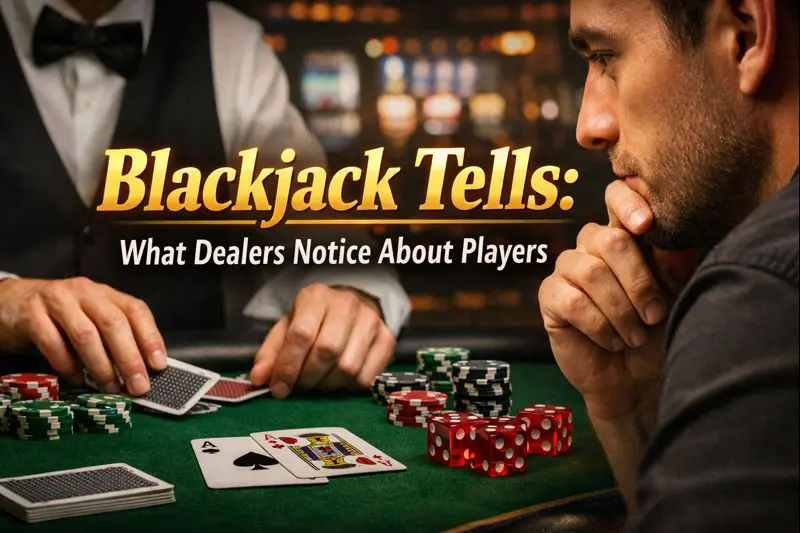
Walk up to a busy blackjack table and the first thing you notice is usually the noise. Chips click, cards slide, somebody groans over a busted twenty, somebody else celebrates a lucky double down like they just cracked a vault. It feels chaotic from the player side. From the dealer side, it often looks a lot more orderly.
That is the part many players miss.
Dealers are not sitting there trying to outplay you in the strategic sense. They are not your opponent in the way a poker rival is. The house edge already does that job. What a good dealer does notice, though, is behavior. Tiny pauses. A hand that hovers over chips a second too long. The player who gets chatty only when the count is rich. The player who suddenly stops joking the moment real money is on the felt. Those details add up fast.
When people hear the phrase blackjack tells, they usually picture some dramatic movie moment where a dealer spots a twitch and instantly knows a player’s next move. Real life is less theatrical and more practical. Tells in blackjack are often about comfort, habit, and inconsistency. Dealers see hundreds of hands in a shift. They develop a sharp eye for what looks normal and what does not. A player usually notices the cards first. A dealer often notices the person attached to them.
That difference matters more than most casual players think.
Blackjack is not poker, but people still give themselves away
A lot of newcomers assume tells matter less in blackjack because many decisions are mechanical. Basic strategy already tells you what to do in most situations. Hit this, stand on that, split here, never take insurance unless you are counting. Fair enough. But even when decisions are mostly correct on paper, the way people arrive at them says plenty.
An experienced dealer can tell, within a few rounds, who knows basic strategy and who is improvising based on emotion. The experienced player acts with a kind of steady rhythm. They do not look tortured by a 16 against a dealer 10, even though it is an ugly spot. They make the mathematically right play and move on. The uncertain player slows down, looks around for approval, sighs, taps the felt like it is a moral decision, then blames the table when the card goes wrong.
That hesitation is one of the most common blackjack body language cues at any casino table. It tells the dealer the player is not anchored to a system. Once that happens, the rest of the player’s behavior usually follows the same pattern. Their bets drift with mood. Their confidence swings hand to hand. Their table talk starts revealing what they fear.
I have watched enough live blackjack to notice that people tend to leak information most when they think they are hiding it. The guy trying to look stone cold after a big bet often looks less natural than the tourist laughing through a five-dollar shoe. Forced calm is its own tell.
The first thing dealers track is not genius, it is consistency
Dealers notice patterns before players notice that they have patterns. That sounds obvious, but it is the heart of player behavior analysis in casino settings. Humans repeat themselves. They stack chips the same way. Reach with the same hand. Touch their cards, if cards are handled, with the same tempo. Even online live dealer blackjack, where direct physical tells are thinner, timing patterns still show up.
Consistency is what makes a deviation stand out.
A player who always bets one unit and suddenly jumps to five after three low cards have passed is waving a flag, whether they mean to or not. A player who jokes constantly but goes silent before doubling down on a soft hand is showing stress. A player who normally makes decisions instantly but starts tanking in high-pressure spots is announcing uncertainty.
This is where gambling psychology matters more than most strategy articles admit. Many blackjack mistakes are not knowledge problems. They are emotional regulation problems. Players know, at least roughly, what they should do. Then a losing streak, a loud opinion from third base, or one ugly split makes them abandon structure. Dealers see that pivot happen in real time.
They also get very good at spotting the difference between a strong player and a lucky one. Lucky players get louder. Strong players get steadier.
Hesitation is the loudest tell at the table
If I had to pick one signal dealers read better than players do, it would be hesitation. Not just long pauses, but the specific flavor of them.
There is the pause of a beginner who genuinely does not know the right play. That one usually comes with eye movement, a glance at the dealer upcard, then a quick scan of the other players as if a stranger’s face might contain mathematical truth. There is the pause of the nervous player who knows the move but hates how it feels, like hitting hard 16. That pause often comes with a half shrug, tightened jaw, or a verbal disclaimer such as “I know this is wrong, but…” right before making it even more wrong.
Then there is the pause dealers really notice: the selective pause. A player moves briskly through ordinary spots, then slows down only when the shoe gets favorable or when the wager is out of character. That is one of the classic betting pattern changes that gets attention. It does not prove card counting, and casinos know that. But it does tell the room that something beyond casual instinct is happening.
Most people think card counters look like math professors. In reality, many look like people trying very hard not to look interested. That effort creates its own rhythm. Dealers and pit staff are trained to notice rhythm disruptions more than stereotypes.
Emotional reactions travel farther than words
Casino players often obsess over hand signals and chip handling, but emotional reactions are even easier to spot. Wins and losses hit the body before the mouth can clean them up. Shoulders loosen after relief. Breathing changes after a bad beat. A player who claims to be unfazed often betrays themselves with the speed of their next bet.
This is one reason dealers can often sort players into rough categories very quickly. The recreational player chases feelings. The disciplined player chases process. The frustrated player tries to win back control. The overconfident player starts narrating the table like a sports commentator the moment variance swings their way.
None of this means the dealer is manipulating outcomes. They cannot. The cards are the cards. But they are reading the energy of the table constantly because that is part of the job. Smooth games depend on predicting trouble before it becomes trouble. A player throwing out angry chips after a loss, arguing over a basic strategy decision, or tipping well only when hot are all examples of behavioral patterns that matter operationally.
That is why dealer observation skills are as much about table management as gambling. The best dealers keep a game moving, keep disputes small, and spot escalating behavior early. Reading tells is woven into that.
Can dealers spot card counters from tells alone?
Not reliably from a single tell, and anyone who says otherwise is overselling it. But dealers and floor staff are not looking for one magic clue. They look for clusters. Betting spread, decision accuracy, emotional flatness, attention to the discard tray, and timing changes all matter more together than alone.
A lot of amateur counters trip themselves up because they become overly careful in the wrong places. They think the secret is hiding their intelligence. So they start performing casualness. They drink too slowly, talk too much, or suddenly make a theatrical “mistake” that does not fit the rest of their game. Ironically, genuine casual players are much more random. Fake casual behavior often looks rehearsed.
This is where the myth of dealer tells gets flipped around. Many players sit down wondering whether they can read the dealer. Usually they should be asking whether the dealer has already read them.
And to be fair, dealers are not always focused on you with forensic intensity. A full blackjack table is busy. There are payouts, side bets, disputes over hand totals, and the constant mechanics of dealing. But over a long session, even busy dealers absorb a surprising amount. Repetition sharpens observation. The same way a barber notices a haircut grown out by half an inch, a dealer notices when a player’s behavior no longer matches their baseline.
The strangest tell is overconfidence
Nervousness is easy to understand. Overconfidence catches more people off guard. Some players think confidence signals competence. At the blackjack table, exaggerated confidence usually signals insecurity or a short winning streak.
You see it when someone starts giving unsolicited advice on every hand. You see it when a player treats basic strategy like a personality trait instead of a chart. You see it when a person turns one successful insurance bet into a full identity as a “feel” player. Dealers have seen too much variance to be impressed by bravado. In fact, loud certainty is often a reliable clue that the player is being driven by recent outcomes rather than sound decision making.
A seasoned blackjack player usually looks less dramatic than the movies suggest. They know blackjack is a game of tiny edges, long stretches of boredom, and disciplined repetition. There is not much to puff your chest about when your edge, if you have one at all, is measured in fractions of a percent.
That is why confidence signals in blackjack are tricky. Quiet certainty tends to be real. Performed certainty tends to crack.
If you do not want to give off tells, simplify your behavior
The cleanest way to avoid readable tells is not to become some expressionless robot. That almost always backfires. The better move is to reduce unnecessary variation. Use a consistent betting approach. Learn basic strategy well enough that common hands do not become emotional theater. Keep your reaction to wins and losses within the same narrow band. Make decisions at a stable pace.
When players ask how to look less obvious, they often mean how to look less nervous. Usually the answer is to become less conflicted, not less human. Most obvious tells come from internal argument. You know the right play but hate it. You want to press a winning streak but feel guilty about it. You are trying to appear relaxed while mentally calculating every exposed card. The conflict leaks out.
A player with a simple framework gives away much less. They are not harder to read because they are mysterious. They are harder to read because there is less noise.
That applies to ordinary casino visitors too. Even if you are not trying to beat the game, understanding tells makes you better at reading the table. You start noticing who is making calm decisions and who is chasing emotion. You notice when advice from another player comes from conviction rather than competence. You also start seeing how much of blackjack happens before the card lands. A lot of the game is really about decision timing, stress tolerance, and discipline under repetition.
The cards matter, of course. But the people matter more than most players think.
That is what dealers notice before you do. Not some mystical secret, not x-ray vision, not a supernatural read on the next hand. They notice patterns, pressure, rhythm, and the small cracks people show when money and uncertainty meet. At a blackjack table, the smartest person is not always the one doing the math. Sometimes it is the one quietly watching everyone else react to it.